This isn’t just an AI content recognition guide — it’s a guide to recognising AI content
AI
Marketing

The Start
Creative Director at The Start
From shit-canning AI tropes, to those who carry them onto LinkedIn without sparing our eyes a second thought — this is more than another guide to spotting AI patterns in writing. It’s an AI content recognition guide. Whether it’s an overly dramatic sentence structure or an influx of Oxford commas and really long dashes, we’re here to weed out the biggest giveaways of AI-written content. Because great writing isn’t just dying — it’s getting really cringey to read.
That was a joke. No, seriously.
We’re sick of it. You’re sick of it. We’re both still copping it when the clock’s ticking and we can’t think of anything more inspired to write.
ChatGPT has bulldozed the art of creative writing and unique advertising copy in flying colours. With it, our voices have melted into one vanilla, unseasoned bore.
5 years ago, writing was just something you had a punt at based on whatever you had to say. Maybe not grammatically correct, or with quite the right application of words, but at least it was original. As the world has caught on that AI isn’t a fleeting trend – and does, in fact, speed up your workload – the masses have flocked to ChatGPT and co. to write just about anything.
We all like to preach that it’s easy to recognise and that its lifespan is short – but somehow, we’re only seeing more of it. Heinz cans, bus stops, emails, and, worst of all, self-indulgent LinkedIn thought leadership that insists on dramatising things that were never dramatic to begin with.
At this point, not using it may actually be the new using it.
In this article, we’re tackling the biggest giveaways of AI writing and why it’s worth taking a second (or sixth) pass over your prompt outputs for the greater health of your brand.
It’s not *insert thing*. It’s *insert loose relative of said thing*.
Of all the detectable AI tropes, this one has to be our most abysmally favourite. The “It’s not just X — it’s Y” sentence structure is the classic attempt to make something sound deeper than it is, usually to convince you that whatever product, service, or positioning statement is being sold is somehow more meaningful than its lesser counterpart.
Commonly sighted in closely related variants like its half-sister “we’re not X, we’re Y,” distant cousin “it’s more than just X, it’s Y,” and that cousin’s little brother “it’s not about X, it’s about Y.” Together, they form the royal family of overwritten AI clichés, and arguably the most misused of them all.
We know it sounds hyper-specific and maybe a little jaded, but the day you see something described as not just the thing it very clearly is – dressed up in a roundabout way that only makes it sound cooler to the writer – you’ll understand.
To be fair to AI, it probably only surfaced this one so often because of years of LinkedIn’s inherently aspirational, self-righteous content slop. Since then, it’s become an echo chamber – the more people who think it sounds good and hit “post,” the more the model learns that this must be ground zero for writing something thought-provoking. It ain’t.
Though, if you’re determined to turn a profoundly dull think piece on the benefits of staying back late or doing an ice bath into a Pulitzer-winning article, this might just be your only hope.

From this one thing to that other thing.
A certified AI favourite when trying to describe range or capability. The age old “from X to Y, we’re Z” structure gets leaned on to create a sense of abundance… etherealness… bullshit.
When there’s not a whole lot sitting between that first from and the last to, this line is Rolls Royce of making it sound like there is.
In the same vein, “whether it’s A or B” makes a frequent cameo as a neat little switch-up to keep things fresh, usually tacked onto the end of the same paragraph for reiteration.
We get it – sometimes it’s hard to describe things without sounding stale or boring. We’ve been there. But next time, try just saying what you actually do and why you do it. It’ll sound clearer, sharper, and a whole lot less like you’re padding out thin air.
The start of grammar policing.
Maybe the most famous giveaway of AI – the overuse of em dashes and, in Australia, the Oxford comma (that extra comma before and in a list).
We’re not sure who decided the Oxford comma wasn’t okay to use in Australian English, or who decided the em dash wasn’t a legitimate piece of punctuation, or that the small dash isn’t a dash at all, but a hyphen that should only be used to join words together – but this one we’re actually not here to beat down on.
Use the em dash if you like. Whack the comma in even if it’s not “right.” If it reads how you’d actually say it, then it’s right in our books. The reality is, if your readers are screaming foul play over an em dash and not over the aforementioned clichés, they probably don’t read that much.
Choose your words wisely.
There are plenty of other little sentence structures we’ve grown tired of.
- No [x]. No [y]. Just [z].
- Because good [x] calls for [y].
The list could go on forever, but these are just a few that make our eyes twitch a little.
Then there’s the vocabulary itself – the recycled word bank of “professional creativity.” The ones ChatGPT, brand managers, and LinkedIn ghostwriters all seem to share.
Dynamic. Holistic. Resonate. Enhance. Leverage. Pivotal. Refine.
GPT spits out words with the kind of favouritism only a toddler who’s just learned a few could match. Most sound sophisticated enough to get past a client, but say absolutely nothing about what’s being sold. Once you notice them, you’ll start seeing them everywhere – pitch decks, agency websites, corporate manifestos, and “vision” statements that could apply to anything from fintech to floor polish.
AI also loves to throw three near-synonymous words in a row to make something sound weighty: “insightful, forward-thinking, and results-driven.” You can practically hear the keyboard sigh.
If you want your writing to feel human, replace these words with something that actually means something. Be specific and plain. “We help people find the right chair” will always read better than “We provide dynamic seating solutions that resonate with your rear”.
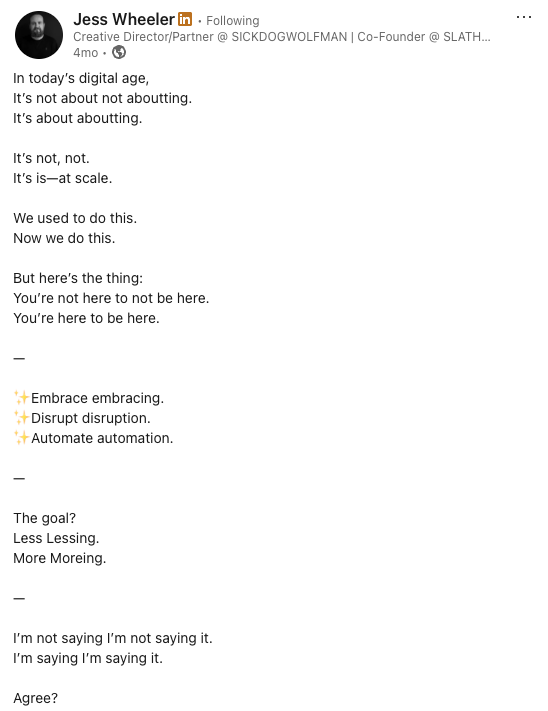
Credit to Jess Wheeler for tackling this a while back on LinkedIn (attached). He summed up perfectly just how absurd most “thought leadership” sounds now. It’s satire, but only just – which is kind of the whole problem. Have a read.
Is it really that deep?
In all seriousness, these clichés mostly live in marketing, advertising, journalism, and promotional speak – the worlds closest to ours, and likely yours if you’ve read this far. If we’re talking about mega-technical reports, stakeholder crisis communications, or presidential speeches, we can’t offer much on how well AI holds up – though from where we’re standing, it doesn’t seem half bad.
That’s beside the point. While these trends might seem like a mild annoyance or a little spot-the-bot moment when you notice them, the influx of this style of writing is only going to grow, and audiences are getting a lot less forgiving.
Attention spans are fragile. Brand relationships are wobbly. It’s no longer sustainable to represent yourself with obviously AI-written content in a space where everyone else already is.
Like every other art form it touches, AI is not a replacement, but a tool. Have a crack at writing your own shit. Get your truest thoughts out. Make a joke that only a few people will get. See if AI can tidy it up or throw a few ideas back. At least then you’ve laid the groundwork for a tone of voice and some substance for it to actually strengthen.
Hopefully we’ve ribbed these clichés hard enough that the next time you spot one, you’ll think twice before settling for it.
If there’s a takeaway here, it’s that your voice and taste still matter. A lot. The moment everything starts to sound the same, the only thing that stands out is what doesn’t. And as a bonus, your EDMs won’t be used as an example in articles like this.
Time for one more?
Back to the pulse
AI
General
Did We Ruin Music Before AI Got the Chance To?
A slightly controversial look at how streaming platforms, algorithms, and our own passive consumption set the stage for AI's arrival in music. Read More